
Losing Medicaid Isn't a Discharge: Protecting Continuity of Care Under H.R.1
A patient who loses Medicaid has not been discharged. Nothing about their diagnosis or their treatment plan changed on the day the state closed their case. A record in an eligibility system changed.
That paperwork event can set off a clinical one. Some patients who get a termination notice assume they can't come back, so they stop coming. The weeks between losing coverage and losing the patient are the part of H.R.1 your organization still controls.
Our last piece looked at what the early-adopting states mean for your schedule and your revenue. This one follows the patient. Under H.R.1, a patient at risk of losing coverage passes through four moments where continuity of care either holds or breaks, and each one asks something different of your team.
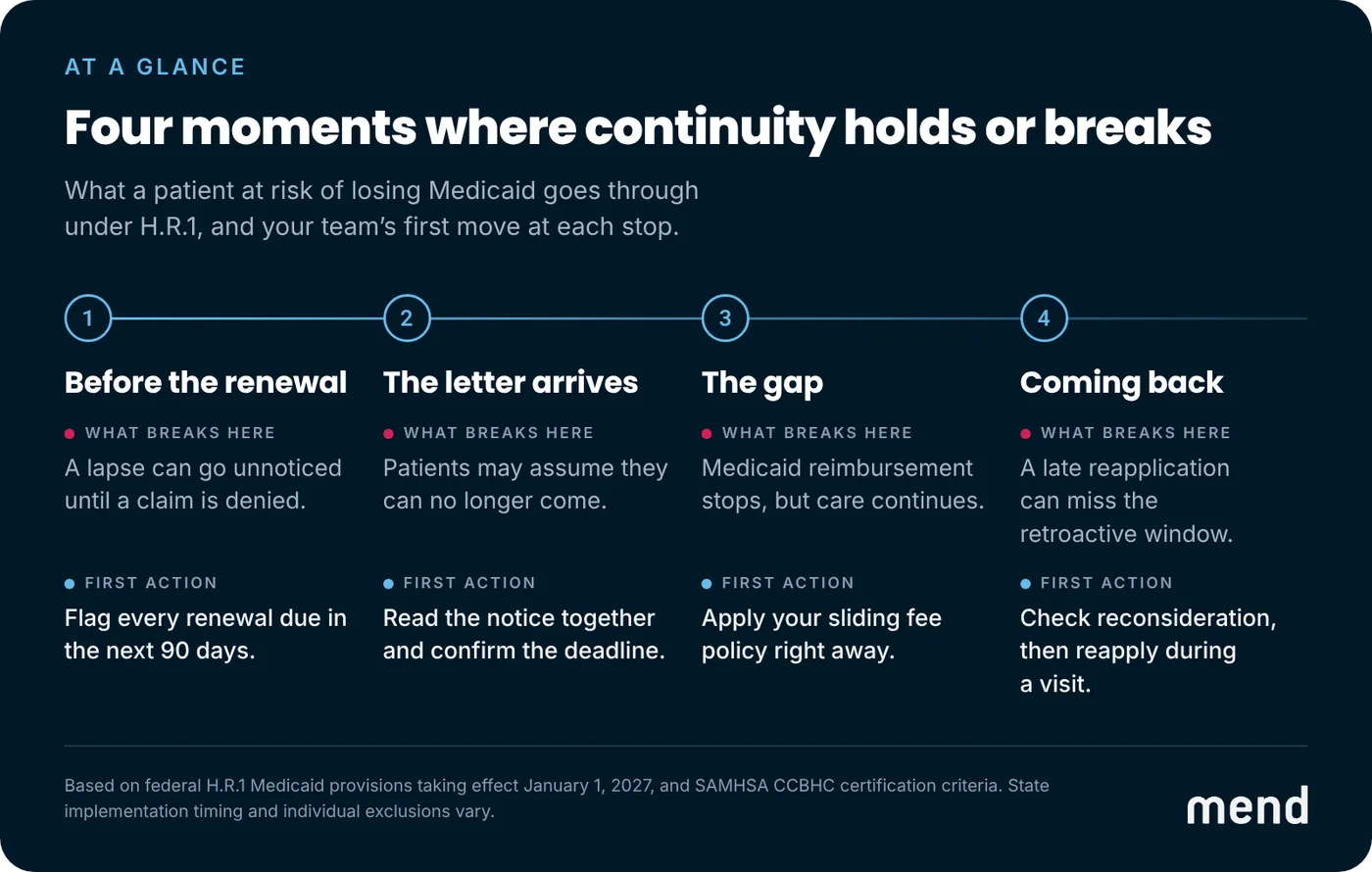
Moment one: before the renewal
Beginning with renewals scheduled on or after January 1, 2027, most Medicaid expansion adults will move to eligibility reviews every six months ( Virginia DMAS). States generally must implement the new community engagement requirement by that date, although implementation timing and individual exclusions vary. For your organization, that means more frequent renewal checkpoints for most expansion patients.
Some organizations discover a coverage loss only after a claim is denied. By then, the patient may already be gone. Continuity starts earlier, with a simple list of who is due for renewal in the next 90 days, treated as a clinical list rather than a billing one.
What helps at this moment:
Make renewals visible. Flag upcoming renewal dates where front desk staff and care coordinators will see them at check-in.
Help with documents before the state asks. Pay stubs, class schedules and volunteer hours are easier to gather while the patient is still engaged. Then make sure they actually reach the state Medicaid agency.
Identify possible exclusions early. Some behavioral health patients may qualify as medically frail. Under current CMS rules, a qualifying condition must significantly impair their ability to meet community engagement requirements. Clinicians can help document that impairment when the state needs additional evidence.
Moment two: the letter arrives
A termination notice tells the patient their coverage is ending. What many patients hear is that they can no longer come. They don't call to ask. They just miss the next appointment, and nobody on your team knows why.
This is the most fragile moment in the continuum, and it's also a window. A notice can announce a future end date rather than an immediate one. When community engagement can't be verified, enrolled patients generally have 30 days to respond while their coverage continues, and fair-hearing rights still apply. Acting quickly here may prevent the gap altogether.
What helps at this moment:
Read the notice together. Confirm the reason, coverage end date and response deadline. Help the patient decide whether submitting missing information, requesting reconsideration, appealing or reapplying is the right next step.
Change the first message. Lead with "you can still come in" before anything about balances, paperwork or next steps.
Watch for silence after a renewal date. An unconfirmed or missed appointment in the weeks after a known renewal is a signal. Reach out by text and phone, ideally from someone the patient already knows.
Treat the miss as a clinical flag. A patient who disappears after losing coverage deserves the same follow-up as any other change in risk, including your usual safety protocols.
Moment three: the gap
For CCBHCs, losing coverage doesn't end the obligation to treat. Federal certification criteria require that no one be denied behavioral health services because of inability to pay, with fees reduced or waived when necessary under a published sliding fee discount schedule ( SAMHSA CCBHC criteria 2.d). The obligation to provide care continues even when Medicaid reimbursement stops. Other funding may help support uninsured care, depending on the clinic's grants and funding arrangements.
That turns the gap into a balancing act: keeping every patient connected while keeping the clinic financially steady. Outpatient groups outside the CCBHC model face a different rulebook but the same patients.
What helps at this moment:
Assess financial assistance immediately. Apply your sliding fee policy, including fee reductions or waivers when needed, as soon as coverage ends rather than after the first unpaid visit.
Make remaining charges easy to pay. For charges left after assistance, payment by text and simple payment plans keep a balance from becoming the reason someone stays away.
Keep medically necessary care on the schedule. That holds regardless of ability to pay. Clinical leadership should set clear rules for visit cadence during the gap, starting with patients at higher risk or on medication management.
Protect the relationship. Keep the same clinician and, where possible, the same time slot. Familiarity is part of what keeps people coming back.
Moment four: coming back
Re-enrollment used to come with a cushion. Medicaid could cover up to three months before the month someone applied. For applications made on or after January 1, 2027, that drops to the one calendar month before the application month for expansion adults, and two months for other groups. The patient also must have been eligible when the care was delivered ( Justice in Aging).
That changes the math on every week of delay. If a patient takes three months to reapply, most of the care you delivered during the gap may fall outside Medicaid's retroactive coverage window.
Arkansas's 2018 work requirement illustrates how difficult returning to coverage can be. An early-2019 analysis found that only 1,910 of the 18,164 people who lost coverage under the work and reporting requirements, about 11 percent, had reapplied and regained coverage ( KFF).
What helps at this moment:
Check reconsideration before starting over. If coverage ended over paperwork, ask whether reconsideration is available before filing a new application. It may restore coverage faster.
Start any reapplication during a visit. The best time to begin is while the patient is sitting with someone they trust, not after they've left.
Act before another calendar month passes. For expansion adults, retroactive eligibility generally reaches only the calendar month before the application month, provided the patient met eligibility requirements when care was delivered.
Close the loop when coverage returns. Bill what retroactive coverage allows, then tell the patient their care is covered again. That message is part of keeping them.
A 90-day continuity plan
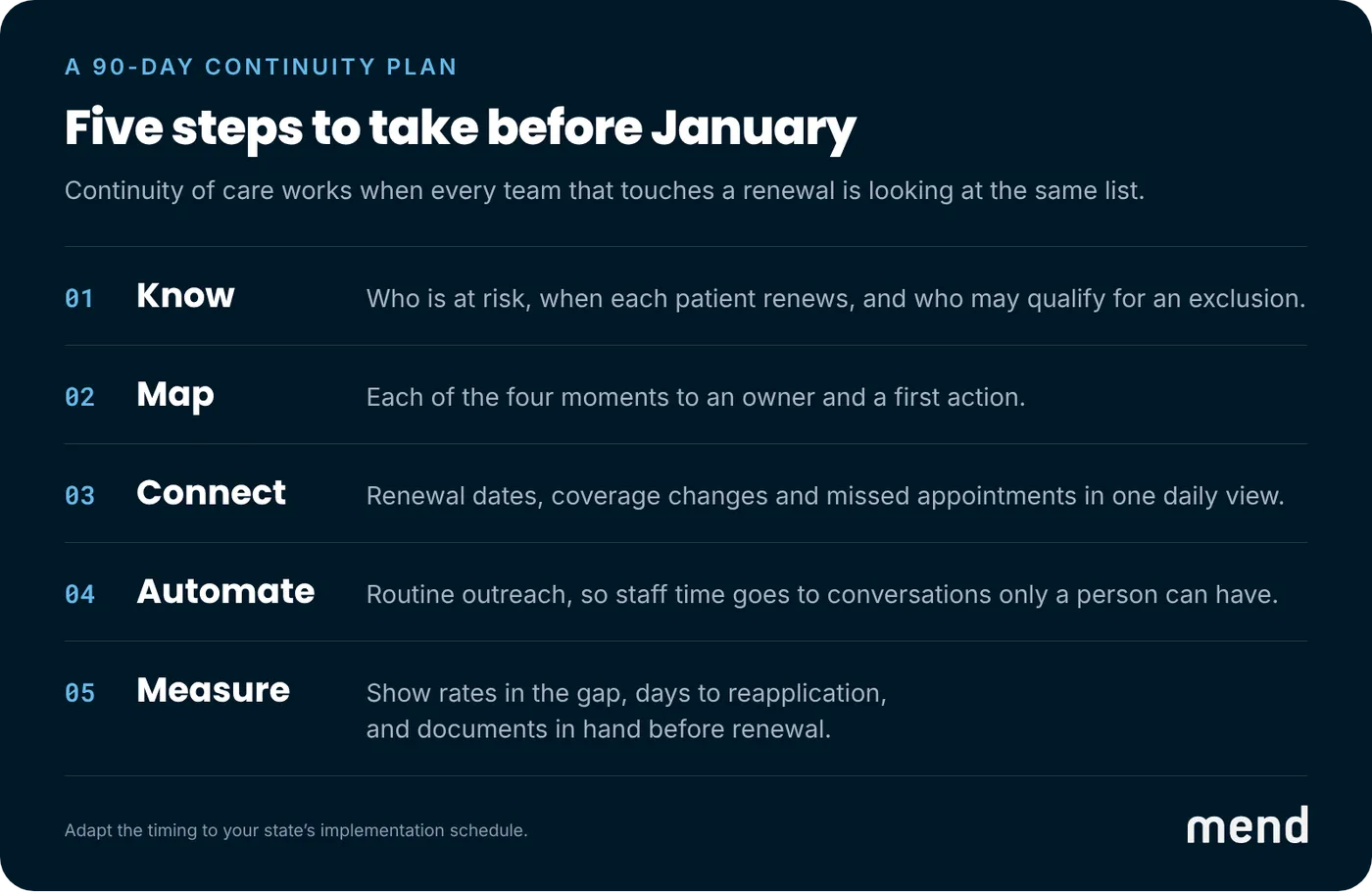
Continuity of care doesn't belong to one department. Access staff see renewal dates and billing sees denials first, but care coordinators and peer specialists hold the relationships. The plan works only when they're all looking at the same list.
Know who is at risk: every expansion patient, their renewal date, and whether they may qualify for an exclusion.
Map how eligibility is verified today and how exceptions are handled, so every team works from the same picture.
Connect the signals: renewal dates, coverage changes and missed appointments in one view your team checks every day.
Automate the routine outreach, including confirmations, document requests and payment links, so staff time goes to conversations only a person can have.
Measure what continuity looks like: show rates for patients in the gap, days from coverage loss to reapplication, and the share of renewals with documents in hand before the due date.
Where Mend fits
Mend handles the parts of this plan that depend on reaching patients at the right moment. Coordinate™ confirms upcoming appointments, surfaces late cancellations and rebooks open slots. When a patient's reply suggests a risk of self-harm, Coordinate shares crisis resources, including 988, and alerts your staff.
Text-based payments, including options to pay over time, make remaining charges easier to manage without a trip to the front desk.
Some of your patients will lose coverage next year. Whether they lose care too is still up to you.
Join us on October 14 at 1 p.m. ET for January's Waiting Room: A 90-Day Care Continuity Plan for an H.R.1 World, a National Council webinar featuring a community behavioral health organization that's already getting ready. Or schedule a demo, and we'll look at what your confirmation, no-show and collections data say about your exposure before January.
Sources
Found this useful?
Share it with your network on LinkedIn.