
Five States Went Early on Medicaid Work Requirements. Here's What Behavioral Health Leaders Should Take From It.
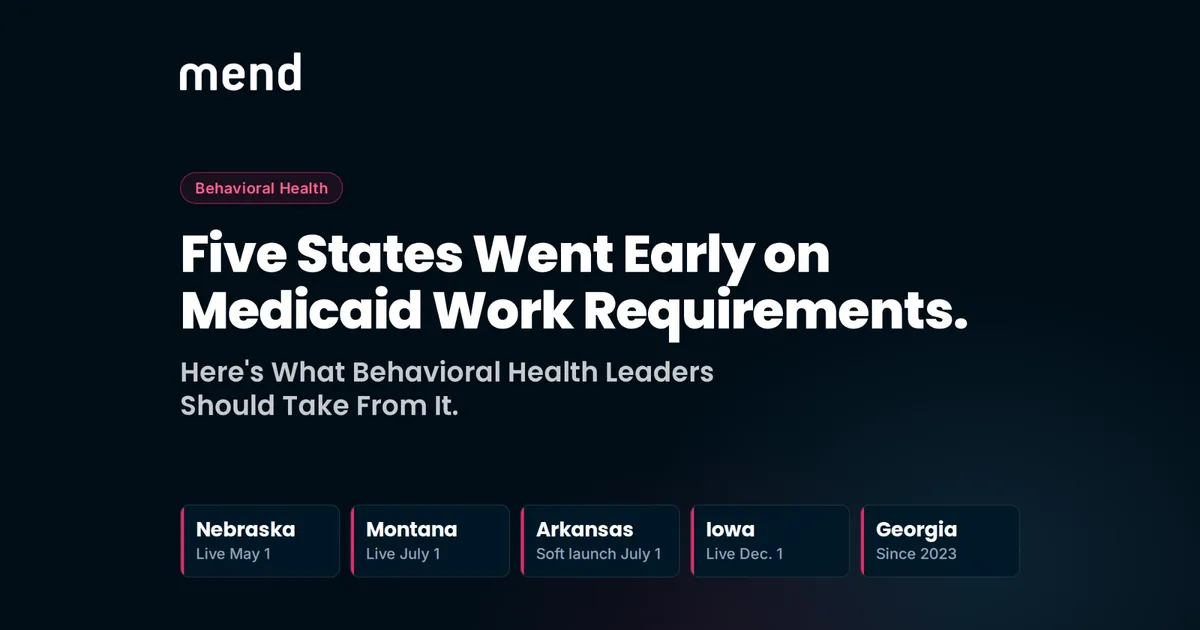
Most of the country has until January 1, 2027 to implement the Medicaid work and community engagement requirements in H.R.1. A handful of states didn't wait. Nebraska turned them on May 1. Montana followed July 1, with enforcement starting October 1. Arkansas began a "soft launch" in July, verifying compliance without disenrolling anyone until the new year. Iowa goes live December 1. Iowa's legislative fiscal analysis estimates about 32,000 people will lose coverage. And Georgia has been running its own version, Pathways to Coverage, since 2023.
That gives the rest of us something rare in healthcare policy: a preview. Not projections, not modeling, but actual states running the actual rule on actual people. What they're seeing so far is worth a few minutes of your attention, because the pattern that's emerging isn't really about eligibility. It's about paperwork, your schedule, and what happens to a patient's bill when their coverage disappears.
What the early states are showing
)
Nebraska is the only state with disenrollment numbers so far, and they're modest to start. As of July 19, the state had denied 317 new applications and 65 renewals for failing to meet the requirement, and its Medicaid director expected about 200 existing members to lose coverage starting August 1, with monthly rounds continuing from there. Experts cited by Healthcare Dive estimate that 20,000 to 40,000 of the roughly 70,000 Nebraskans subject to the rule will eventually lose coverage. The Department of Health and Human Services didn't add staff to handle it. Advocates report hold times of up to 90 minutes and at least one pregnant applicant wrongly denied. One federally qualified health center in Lincoln told the Nebraska Hospital Association it expects to lose 10 to 15 percent of its 8,400 Medicaid patients and somewhere between $400,000 and $600,000 a year.
Montana's numbers are projections for now, since enforcement doesn't begin until October. Published estimates range from 10,000 to 30,000 of its 74,000 expansion enrollees losing coverage, even though 72 percent of them already work or attend school. Before the rule took effect, Montana was already processing 35 percent of Medicaid applications past the 45-day federal limit and had the second-worst call abandonment rate in the country. The system that has to verify 74,000 people's work hours is the same one that was struggling before it had to.
Arkansas is the state to watch closely, because Arkansas has done this before. In 2018, the state ran a work requirement for seven months before a federal judge stopped it. In that window, 18,000 people lost coverage, one in four of everyone subject to the rule. The Harvard researchers who studied it found no increase in employment. What they found instead was that among people who failed to report their hours, 99 percent had logged zero activities. These weren't people who stopped working. They were people who didn't understand the rule, couldn't navigate the portal, or never got the letter. Only 11 percent of them ever got coverage back. This time around, Arkansas's own estimate is that about 42,000 people, roughly 20 percent of its expansion population, will lose coverage after January 1.
Georgia's story is the long one. Nearly three years in, Pathways had 16,782 people actively enrolled as of April 30, 2026, against a first-year projection of 25,000. The state has spent more than $54 million on administration and about $26 million on actual care. Researchers at Emory found no measurable increase in employment.
If you're looking for a single sentence to take from all of that, it's this: the people losing coverage are overwhelmingly people who were eligible and lost it on paperwork.
Why this lands harder on behavioral health
Every provider who takes Medicaid is going to feel some of this. Behavioral health organizations are going to feel more of it, for reasons that are structural rather than unlucky.
Start with who's in the pool. According to KFF, about 24 percent of Medicaid expansion adults have a diagnosed behavioral health condition. Six in ten Medicaid adults with a substance use disorder are covered through expansion, which is exactly the population the work requirement applies to. If your organization serves adults with anxiety, depression, or SUD, a quarter or more of your Medicaid panel is subject to this rule.
Then look at the exemption. H.R.1 exempts people who are "medically frail," which includes disabling mental disorders and substance use disorders. That sounds like it should cover most of your patients. It won't. The interim final rule CMS issued in June narrowed the definition: a diagnosis alone doesn't qualify. The patient, or their provider, has to document functional impairment that prevents them from meeting the 80-hour threshold. Your patients with serious mental illness will likely qualify. Your patients with mild-to-moderate depression, generalized anxiety, or early-stage recovery mostly won't, and there are a lot more of them.
And here's the part that should worry you most: those are precisely the people least equipped to handle six-month reporting. The symptoms that bring someone to your door in the first place, trouble concentrating, feeling overwhelmed, avoidance, are the same symptoms that make a person miss a deadline, skip a form, or not open a letter from the state. A 2019 Health Affairs study found Medicaid enrollees with serious mental illness were less than half as likely to have worked 20 hours in the prior week compared to enrollees without a health condition. The rule is built in a way that catches the people your organization exists to serve.
Nobody has published a behavioral-health-specific disenrollment figure from Nebraska or Montana yet. When they do, we don't expect it to be flattering.
What this does to your schedule
Coverage loss is the headline. The daily reality is churn.
When a patient loses Medicaid, they usually don't know it until they show up for an appointment or get a bill. Some will find out and stop coming. Some will keep coming while their eligibility is in limbo, and your billing team will chase claims for months. Some will get reinstated and fall off again at the next six-month check. Montana's 2023 redetermination unwinding gave a preview of what this looks like inside a clinic: one substance use treatment program in Kalispell reported it couldn't bill for 42 of its 174 clients who were stuck in redetermination, and lost 26 more who simply left treatment because they didn't know whether they were covered. Revenue cycles stretched to four or five months.
For a behavioral health organization already running a 15 to 25 percent no-show rate, this is the wave coming toward the beach. Starting in Q1, more of your scheduled patients will arrive ineligible, or won't arrive at all because they're confused about their coverage. Your no-show rate is about to get worse for reasons entirely outside your control.
What you still control
You can't control who the state disenrolls or how long the hold times get. But the Arkansas data points at something you can do something about. The people who lost coverage there weren't ineligible. They were eligible people who couldn't get the paperwork in, and then they became patients who either stopped coming or kept coming with no way to pay. Each of those three moments, the paperwork, the appointment, and the payment, is a place where your organization can change the outcome. Mend was built to work at all three.
Keep eligible patients eligible
The single biggest driver of coverage loss in every early state is documentation that never made it to the state. Pay stubs, hours, proof of school enrollment, and for the medically frail exemption, provider documentation of functional impairment. Most of your patients don't have a scanner. Nearly all of them have a phone.
Mend's digital intake already lets patients upload documents from their phone before a visit, with no portal and no login. That same capability works for a pay stub or a class schedule. When a patient tells your front desk they got a letter from Medicaid, your team can send them a text, they snap a photo, and the document is in your system the same day, attached to their record. Your staff can help them get it to the state, or reference it when a state caseworker calls to verify an exemption. In Montana, that's exactly how the process works: the patient attests, and the state contacts the provider to confirm. Having the documentation already on file turns a phone call your clinician dreads into a two-minute task.
This isn't a fix for the policy. It is a way to make sure the patients who should keep coverage do, and it's the cheapest revenue protection available to you.
Keep patients showing up
Every appointment you keep between now and January is revenue you can't recover in the first quarter. Every cancellation you refill is a patient who got seen instead of a provider who sat idle.
This is what Coordinate was built for. It reaches out to every scheduled patient ahead of their appointment and gets them to confirm, not just receive a reminder. When a patient cancels, it surfaces the open slot immediately and offers it to patients who've asked to be seen sooner. It runs automatically, in the background, with guardrails built for behavioral health: if a patient mentions self-harm, the conversation stops, the patient gets your crisis line and 988, and someone at your organization is notified right away. Your staff can see every conversation and step into any of them.
Results from Mend customers' first month using Coordinate have been consistent: no-show rates that started around 19 to 20 percent came down to 16 to 17 percent, and stayed there. The pattern we're seeing is that for every 40 percent of appointments that get confirmed, no-shows drop about three points. That's not a projection. It's what's happening in the schedules of behavioral health organizations right now.
What happens once a patient actually loses coverage is its own question. We follow the patient through four moments where continuity of care holds or breaks in Losing Medicaid Isn't a Discharge .
Keep revenue from going to zero
Some of your patients are going to lose Medicaid no matter what anyone does. What happens next is a decision, not a foregone conclusion.
A patient who loses coverage doesn't stop needing care, and most of them don't stop being able to pay something. The question is whether your organization has a way to collect it that doesn't depend on a front-desk conversation nobody wants to have. Mend Payments handles that quietly: a sliding-fee or self-pay balance goes to the patient by text, they pay from their phone, and a card on file or a payment plan keeps the next visit from turning into another collections problem. Organizations using Mend Payments are already collecting balances they'd written off, from patients who were never going to mail a check. The same tool keeps a patient who just went from Medicaid to self-pay at $40 a visit instead of at nothing.
Put the three together and the math changes. The patient who would have lost coverage keeps it because their pay stub got in. The patient who would have no-showed confirms. The patient who did lose coverage keeps coming and pays what they can. None of it makes H.R.1 go away. All of it keeps your organization's revenue from dropping in lockstep with the state's enrollment numbers.
The timing matters
There are three months left in 2026. That's enough time to turn on Coordinate, see the first month's numbers, and walk into January with a lower baseline no-show rate than you have today. It's enough time to get document upload in front of your front desk before the first exemption letters land. And it's enough time to have a self-pay path ready before the first patient tells you they've been disenrolled.
The early states have told us what's coming. What happens inside your organization between now and then is still up to you.
Schedule a demo and we'll walk through what your own confirmation, no-show, and collections data suggest Mend can do for your organization before January.
Sources
KFF, Tracking Implementation of the 2025 Reconciliation Law Medicaid Work Requirements (updated September 9, 2026).
Nebraska Public Media, "Nebraska becomes first state to disenroll Medicaid recipients under new work requirements" (July 31, 2026).
Nebraska Hospital Association, "Nebraska Hospitals Warn Medicaid Work Rules Could Disrupt Care" (April 14, 2026).
Montana Free Press, "As Montana's Medicaid work requirements loom, questions about system gaps remain" (July 1, 2026).
Arkansas Advocate, "Arkansas has begun a 'soft launch' of Medicaid work requirements" (July 6, 2026).
Center on Budget and Policy Priorities, "Pain But No Gain: Arkansas' Failed Medicaid Work-Reporting Requirements.".
Sommers et al., Health Affairs, "Medicaid Work Requirements in Arkansas: Two-Year Impacts on Coverage, Employment, and Affordability of Care" (2020).
Emory Rollins School of Public Health, "What Three Years of Georgia's Medicaid Work Requirement Show" (July 29, 2026).
KFF, "Implications of Medicaid Work and Reporting Requirements for Adults with Mental Health or Substance Use Disorders" (June 23, 2025).
CMS, Medicaid Community Engagement Requirement Interim Final Rule (CMS-2454-IFC, June 2026).
Wen, Saloner, and Cummings, Health Affairs (April 2019).
Montana Independent, "Changes in Medicaid 'the perfect storm'" (December 2023).
Healthcare Dive, coverage of Nebraska's work requirement rollout (2026).
Georgians for a Healthy Future, Pathways to Coverage enrollment update (June 18, 2026).
Iowa Legislative Services Agency, fiscal note on SF 615.
Found this useful?
Share it with your network on LinkedIn.