
Why Behavioral Health Leaders Are Stockpiling Cash Before January, and How They're Doing It
Last week the Chief Information Officer of a community mental health center told us exactly why her organization is turning on Coordinate now rather than in the spring. Her words, lightly cleaned up: "We're interested in anything that will help us stockpile cash to navigate H.R.1."
That's the whole strategy in one sentence, and it's worth sitting with. She isn't trying to fix the policy. She isn't waiting to see what her state does with exemptions. She's looking at the calendar, counting the weeks until January 1, and asking a narrower question: what can we do in the next 75 days that puts money in the bank before the rules change?
She's not the only one asking it.
The math behind the question
)
Medicaid work requirements take effect nationwide on January 1, 2027. The rules will differ by state, and nobody can tell you precisely how many of your patients will be affected. What the early states have already shown is the mechanism: people who qualify for coverage losing it anyway, over verification and paperwork, and providers finding out when a prescription or an authorization gets denied. For a behavioral health organization, that shows up as a schedule with more holes in it and a billing team chasing claims that may not pay.
You can't control any of that. What you can control is the revenue you capture between now and then. A CCBHC running 150 providers at a 20 percent no-show rate is leaving somewhere between $100,000 and $300,000 a month on the table depending on payer mix and visit type, and most of that is recoverable with nothing more than getting patients to confirm and filling the slots that open up. Every month of that you capture before January is cash that's in your account when the first-quarter numbers come in soft.
That's what "stockpiling" means here. Not a new revenue source. The revenue you were already supposed to be getting, collected now instead of never.
What the first 30 days look like
)
The reason this has moved from theory to practice is that organizations have started turning Coordinate on, and the first month's numbers have been consistent enough to plan around.
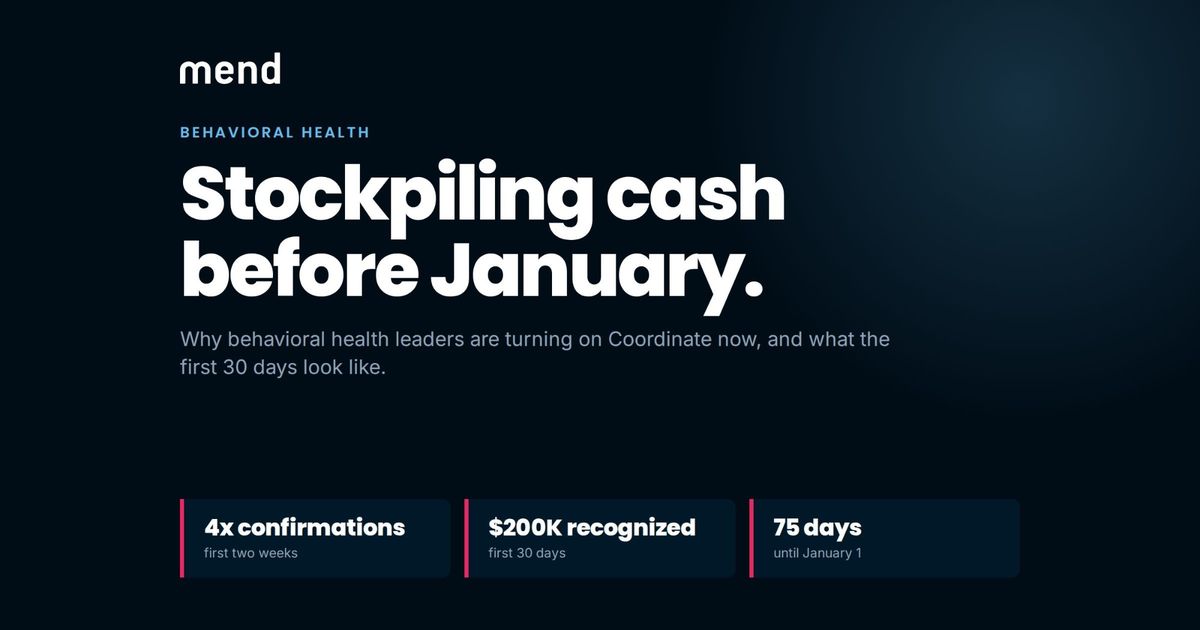
A CCBHC in Indiana, which has some of the strictest work requirements in the country taking effect in January, saw appointment confirmations surge roughly four times over in the first couple of weeks. Confirmations are the leading indicator: a confirmed appointment is one that happens, and the no-show rate follows it down. Their no-show rate moved from the 19 to 20 percent range toward 16 to 17 percent within the first month and has held there.
A CCBHC in Michigan reported about $200,000 in newly recognized revenue in the first 30 days of use. That's not a projection or an annualized figure. It's one month, measured the way their finance team measures everything else: appointments that happened and billed that would otherwise have been empty slots.
And the CMHC whose CIO gave us the quote at the top of this article is going live this month for exactly the reason she described.
None of these organizations is named here because we didn't want to wait for a press approval cycle to tell you what's working. If you want to talk to one of them, ask us. Several have agreed to take peer calls.
How it works, in plain terms
Coordinate is Mend's AI coordinator for the schedule. It reaches every scheduled patient ahead of their appointment by text and asks them to confirm, not just reminds them. Patients who don't respond are flagged so your team knows where to follow up. When a patient cancels late, Coordinate surfaces the open slot immediately and offers it to patients who've asked to be seen sooner, so the rebooking happens without anyone picking up a phone.
It runs in auto mode, which is the only way the results above happen. Manual mode means someone has to remember to send the outreach; auto mode means it goes out on time, every time, and the schedule fills itself. Staff can see every conversation and step into any of them. If a patient references self-harm, the automated conversation stops, the patient is given your crisis line and 988, and a designated person on your team is notified immediately.
Coordinate can go live on its own, ahead of any broader Mend implementation. That matters right now, because the window before January is short, and the first month's results are what make the second month's numbers believable to a CFO.
The offer
We know the budget conversation is hard this quarter. Every dollar you spend before January is a dollar you'd rather have in reserve, which is the whole point of the exercise. So Mend is going at risk on Coordinate for organizations that start before the end of the year.
Here's what that means. We'll look at your current confirmation and no-show data and tell you, in writing, what we expect Coordinate to recover. If it doesn't recover at least that much, you can cancel. Otherwise, the solution is already starting to pay for itself before you spend a dime.
There's no free trial here, because you don't have to do anything to test it. You get the value either way. The only thing we're asking you to decide is whether you'd rather have the first month's numbers in November or in March.
What to do this week
Pull your no-show rate and your late-cancellation count for September. Those two numbers are your baseline, and you'll want them regardless of what you do next, because they're what you'll compare January against.
Then decide whether you're going to be one of the organizations with a cushion in the bank when the rules change, or one of the ones calling us in February to ask how the others did it.
Schedule a demo and bring those two numbers. We'll tell you what we think Coordinate can recover for your organization before January 1, and we'll put it in writing.
If you'd rather hear it from a peer first, say so when you book. We'll connect you with a behavioral health leader who's already live.
Found this useful?
Share it with your network on LinkedIn.