
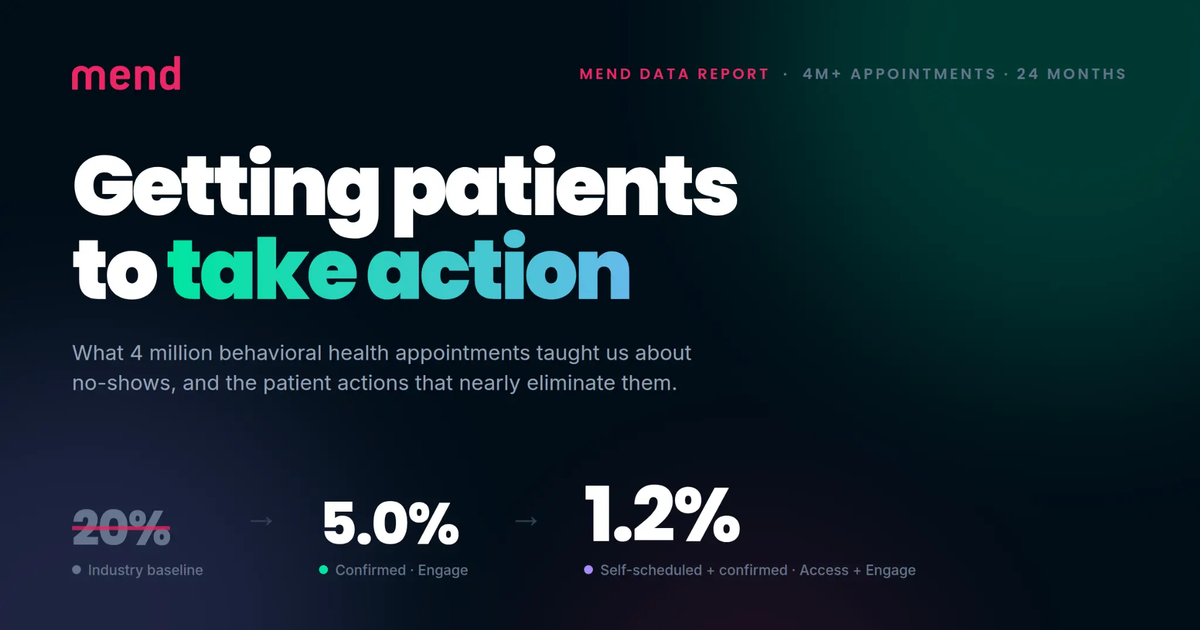
In mental and behavioral healthcare, the patient no-show rate typically runs between 20% and 40%, and it climbs as high as 50% in substance use treatment settings. That makes it one of the highest no-show rates across all of healthcare.¹ ² For comparison, the average across all medical settings is roughly 18%,² and a 2024 analysis of nearly 2 million outpatient encounters found that mental health visits carry nearly triple the baseline odds of a no-show.¹ For safety-net organizations like CMHCs and CCBHCs, published rates run even higher: studies of safety-net clinics have documented missed-appointment rates from 27% to over 41%.¹
Every one of those missed appointments is a patient who didn't get care and a visit the organization couldn't bill.
Mend hypothesized that if we could get patients to take specific actions in the process of their own care coordination, we could positively affect the rate at which they show up for their appointments.
With that in mind, the Mend team rallied around what we would make our superpower: getting patients to take action. Let's jump right into the data from the last 24 months, and then let's talk about how we made it happen.
The Data
The primary action we're reporting on here is the patient confirmation . Organizations using Mend send appointment reminders to patients, who are prompted to confirm their appointment. The data below reflects more than 4 million appointments across Mend customer organizations over the last 24 months.⁶
To translate attendance into impact, we'll use three deliberately conservative assumptions for a composite community behavioral health organization:
A 20% baseline no-show rate, the low end of the published range for behavioral health, and well below what many safety-net organizations actually experience.¹ ²
$150 average revenue per completed appointment (reimbursement plus patient responsibility). For context, CCBHCs paid under a PPS-1 model received an average of $264 per visit-day in federal cost analyses, so $150 is conservative by design.⁵
4,000 scheduled appointments per month. The average CCBHC now serves roughly 6,300 clients per year (3.4 million people across 539 clinics),³ and national data puts outpatient behavioral health visit frequency at roughly 6 or more visits per patient per year,⁴ which pencils out to well above 4,000 monthly appointments for larger organizations.
More access: 4,000 × (20% − 10%) = 400 more patients attending every month — 4,800 more per year.
New recognized revenue: 4,000 × 10% × $150 = $60,000/month, or $720,000 more annually.
More access: 4,000 × (20% − 5%) = 600 more patients attending every month — 7,200 more per year.
New recognized revenue: 4,000 × 15% × $150 = $90,000/month, or $1.08M more annually.
More access: 4,000 × (20% − 1.2%) = 752 more patients attending every month, adding up to 9,024 more per year.
New recognized revenue: 4,000 × 18.8% × $150 = $112,800/month, or $1.35M more annually.
How?
Access
Access is Mend's patient self-scheduling offering. Organizations implement Access directly on their current website, and patients can schedule from the convenience of their web browser on a laptop or mobile device.
Typically, a patient is offered a time at the front desk or over the phone, assumes it will work, and has to check later. Often, they can't actually make it for reasons unforeseen at the moment of booking. When patients self-schedule, they can pull up their own calendar and book a time they know will work. Their attendance likelihood skyrockets, all the way down to that 1.2% no-show rate when combined with confirmation.⁶
Engage
Once scheduled, patients have to-dos before and between appointments.
Before appointments, patients need reminders, and someone has to collect their confirmation that they're going to attend. That job usually falls to an FTE at the front desk or a call center, playing phone tag for hours on end, often unsuccessfully.
On top of that, patient intake has to happen. Patients need to complete forms and screeners, upload their latest insurance card and ID, and update their demographic information. Too often, they show up unprepared, forced to do all of it in the waiting room or, worse, in front of the provider during appointment time. With Engage, patients get all of this done from their computer or mobile device before they arrive.
Engage automates all of it, including the rescheduling workflow when a patient needs to change their appointment time. And for organizations that take patient payments, Mend handles that too: patients can even set up automated repeat payments when needed.
Coordinate
Meet Coordinate, Mend's AI care coordinator, powered by Signal. Coordinate reads every signal in your organization and can engage patients on your behalf: sending reminders, working to confirm appointments, and taking action to get patients to show up. Your team stays in control and in the loop the whole time.
Run the numbers with your organization’s actual appointments and revenue using the calculator below.
Want to know how things are going? Just ask. Coordinate analyzes all of the data your organization has in Mend and delivers back exactly what you're looking for, using conversational language, data tables, and report visualizations.
Signal
The brain behind it all. Signal ingests every scheduling, attendance, engagement, and outcome signal across your organization. It powers Coordinate AI, drives the analytics your operators rely on, and surfaces the leading indicators that tell your team what to do next, before revenue slips or care falls through.
The bottom line
No-shows aren't a fact of life in behavioral health; they're a workflow problem. And when patients take action in their own care coordination, they show up. The organizations proving it are seeing hundreds more patients every month and recognizing seven figures in annual revenue they were already scheduling, just not capturing.
Want to see the math with your organization's numbers? Let's talk.
See what Mend can recover for your organization.
A 60-minute demo. No pressure. Just the numbers.
Schedule a DemoReferences
1. Nierengarten, M. (2025). Behavioral health no-show rates: Benchmarks, causes, and how to reduce them. Tebra. https://www.tebra.com/theintake/patient-experience/behavioral-health-no-show-rates
2. Curogram. (2025). Why no-show rates are higher in mental health — and how to fix them. https://curogram.com/blog/mental-health/mental-health-appointment-no-shows
3. National Council for Mental Wellbeing. (2026, August 4). 2026 CCBHC impact report. https://www.thenationalcouncil.org/news/2026-ccbhc-impact-report/
4. Health Resources and Services Administration. (2025). 2024 Uniform Data System national data, Table 5: Staffing and utilization. https://data.hrsa.gov/topics/healthcenters/uds/overview/national/table?tableName=5&year=2024
5. Office of the Assistant Secretary for Planning and Evaluation. (2019). Preliminary cost analysis of the Certified Community Behavioral Health Clinic demonstration. https://aspe.hhs.gov/sites/default/files/migrated_legacy_files/196041/CCBHCPreCost.pdf
6. Mend. (2026). Internal platform data: Appointment attendance across 4M+ appointments, 2024–2026. [First-party data on file.]
Found this useful?
Share it with your network on LinkedIn.