
$211M in New CCBHC Funding Just Hit the Field. Here's the Operational Bar That Comes With It.
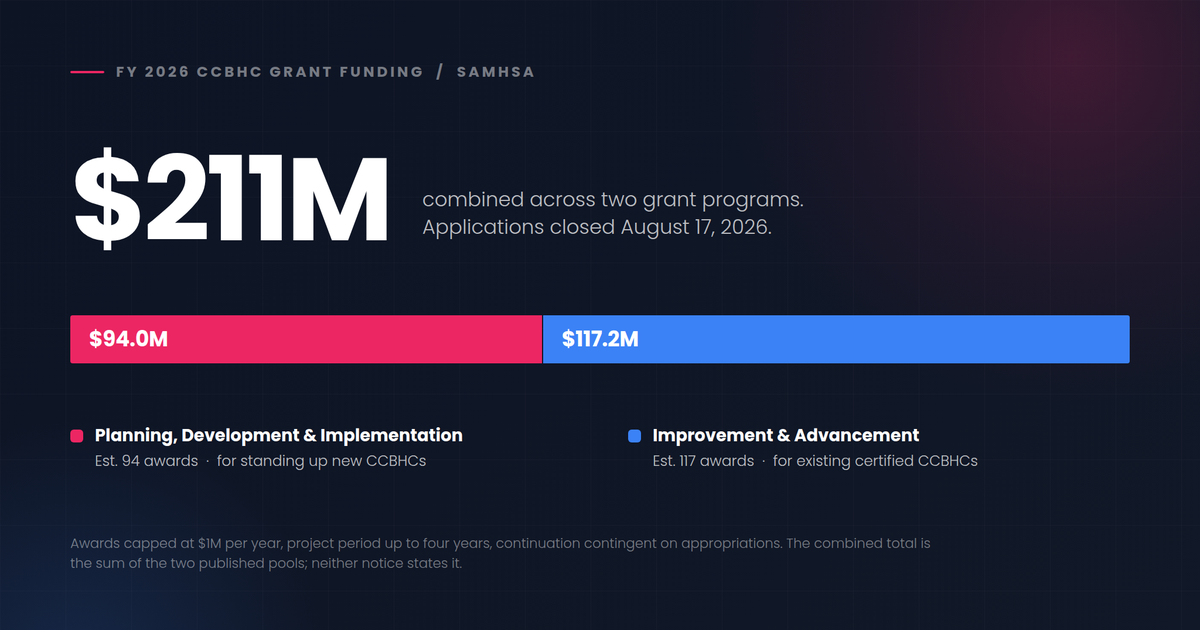
SAMHSA's application window for two Certified Community Behavioral Health Clinic (CCBHC) grant programs closed on August 17, 2026. The Planning, Development, and Implementation (PDI) grant, for organizations standing up new CCBHCs, lists an estimated 94 awards against $94,000,000 in available FY 2026 funding ( SM-26-014; grants.gov listing). The Improvement and Advancement (IA) grant, for organizations that already operate certified CCBHCs and want to sustain and enhance services, lists an estimated 117 awards against $117,160,647 ( SM-26-015; grants.gov listing). Both notices cap awards at up to $1 million per year across a project period of up to four years, with annual continuation contingent on appropriations and performance. Add the two FY 2026 pools together and you get roughly $211 million, a combined figure that neither notice states on its own.
That's a big number, and it's easy to read it as simply "more money for behavioral health." But for the clinics that applied, and for the ones that will win, the more important story is what the funding obligates them to do . Both grant programs, and the state rules layered on top of them, are increasingly explicit about proving access rather than just expanding it.
What grant dollars are actually buying
CCBHC status isn't a funding label. It's a service model. Per SAMHSA's certification criteria, a CCBHC is responsible for ensuring access to nine required service categories, delivered directly or through a Designated Collaborating Organization (DCO): crisis behavioral health services, including mobile crisis teams 24 hours a day, seven days a week; screening, assessment, and diagnosis; person- and family-centered treatment planning; outpatient mental health and substance use services; outpatient clinic primary care screening and monitoring; targeted case management; psychiatric rehabilitation; peer and family or caregiver supports; and intensive, community-based mental health care for members of the armed forces and veterans. The criteria also require the CCBHC organization itself to deliver the majority, meaning 51% or more, of encounters across those required services, excluding crisis services, rather than routing them through DCOs ( SAMHSA CCBHC Certification Criteria, 2023).
Meeting that bar on paper is one thing. Operating it every day, across every intake and every handoff, is another. That's where a growing number of states are stepping in to define what "operating it" actually has to look like.
New York has written down what "proof" would mean
New York's Office of Mental Health (OMH) and Office of Addiction Services and Supports (OASAS) jointly published a revised CCBHC rulemaking, proposed Subpart 600-1, in the State Register on July 1, 2026, following an original proposal in October 2025. The public comment period closed on August 15, 2026. As of August 19, 2026, the two offices had not published a notice of adoption, so everything described below is proposed text that could still change before it takes effect ( OASAS: CCBHC Regulation). The rule exists because the federal CCBHC demonstration authorized under section 223 of the Protecting Access to Medicare Act ended on September 30, 2025, and the two offices needed a state-level oversight mechanism so existing CCBHCs could keep operating. It would be a standing regulatory framework rather than a time-limited demonstration, though the text notes that its reimbursement standards remain contingent on federal financial participation. Several requirements are worth reading closely, whether you operate in New York or somewhere that hasn't drafted its own version yet ( revised rulemaking text):
Discharge follow-up on a clock. CCBHCs would have to track when the people they serve are admitted to and discharged from hospitals and psychiatric facilities, and would have to receive service notifications through those facilities' Admission-Discharge-Transfer (ADT) systems. ADT connectivity is written as a requirement, not a best practice. The CCBHC or its DCO crisis provider would then have to contact the individual within 24 hours of discharge, with coordination with the discharging facility happening before the person leaves rather than after.
Telehealth as a complement, not a substitute. The proposed text permits telehealth but states plainly that "telehealth cannot be the only method for individuals to obtain a CCBHC service." All CCBHC services would have to be available in the modality the individual prefers, with that preference documented in the case record.
Quality measurement built into daily operations. Clinics would maintain a Continuous Quality Improvement plan, collect and report the clinic-collected and state-collected quality measures OMH and OASAS require, and run an EHR with the capacity to collect, report, and track encounter, outcome, and quality data. Visit counts alone would not cover it.
Recertification, not a one-time credential. Certification would run up to three years before recertification is required, so the operational proof would have to hold up on a recurring basis rather than only at launch.
Editor's note: this section reflects the proposed rule as published on July 1, 2026 and verified against the State Register through August 19, 2026. Confirm the current status on the OASAS CCBHC regulation page before relying on any provision for compliance planning.
Proposed or not, the drafting tells you something. These provisions look like a preview of where CCBHC oversight is heading more broadly: fewer static requirements, and more continuous, data-backed evidence that access and coordination are actually happening. New York is simply the state that has written it down most explicitly so far.
The payer side is moving too, but less predictably
The pressure isn't only coming from CCBHC regulators. At the NAIC's Summer National Meeting in Columbus, the Prescription Drug Coverage (B) Working Group and the Mental Health Parity and Addiction Equity Act (MHPAEA) (B) Working Group met in joint session on August 12, 2026 "to consider coverage of prescription drugs used to treat substance use disorders" ( 2026 Summer National Meeting preview; tentative agenda). That single line is the whole of what NAIC's published materials describe. Themes that circulate in industry roundups, such as medication coverage delays, cross-state parity enforcement tracking, or a formal prior-authorization reporting template, do not appear in NAIC's own agenda or preview.
Federal parity policy, meanwhile, is genuinely unsettled, and it's worth being precise about where it stands. The 2024 MHPAEA final rule requires plans and issuers to collect and evaluate data on how non-quantitative treatment limitations (NQTLs) affect access to behavioral health benefits, and to document a comparative analysis for each one ( Federal Register, 2024; DOL fact sheet). On May 15, 2025, however, the Departments of Labor, Health and Human Services, and the Treasury said they would not enforce the portions of that rule that are new relative to the 2013 regulation, while they reconsider it and an industry challenge sits in abeyance. That non-enforcement posture still stood as of August 2026, and the Departments have signaled they intend to propose significant revisions by the end of the year ( tri-agency enforcement statement). What has not changed is the underlying statute. The NQTL comparative-analysis obligations created by the Consolidated Appropriations Act, 2021 remain in force and are still being enforced. If you're planning around parity, plan around the statute rather than the 2024 regulation.
Prior authorization is the clearer signal. CMS's Interoperability and Prior Authorization Final Rule (CMS-0057-F) applies to Medicare Advantage organizations, state Medicaid and CHIP fee-for-service programs, Medicaid managed care plans, CHIP managed care entities, and Qualified Health Plan issuers on the federally facilitated exchanges. Commercial and self-funded plans are outside its scope. Those covered payers have been publicly posting annual prior-authorization metrics since March 31, 2026, when the first reports covering calendar year 2025 came due, and they face a January 1, 2027 deadline to stand up standardized prior authorization, provider access, payer-to-payer, and expanded patient access APIs ( CMS-0057-F overview; CMS prior authorization API FAQ).
The specific instruments will keep moving. The direction they point does not. Whether the audience is a state licensing body, a federal grant officer, or an insurance regulator, the ask is shifting toward less "tell us access improved" and more "show us, with data."
What this means for clinics right now
If your organization applied for PDI or IA funding, or is operating under an existing CCBHC certification, the practical to-do list looks less like "wait for the award letter" and more like an operations audit:
Can your team identify, in real time, who was just discharged from an inpatient or crisis setting, and confirm outreach happened within the required window? Can you report wait times, no-show rates, and referral completion by payer or program without a manual chart pull? If a state auditor or grant reviewer asked for evidence of care coordination next quarter, would you be pulling it from a dashboard or reconstructing it from scratch?
Those questions are worth answering regardless of how any single rulemaking lands. For clinics that already have automated scheduling, reminders, and patient engagement workflows in place, this moment is less disruptive, because the data grant reviewers and regulators are asking for is largely a byproduct of running efficient day-to-day operations. For clinics that don't, the funding window that just closed is a reasonable deadline to start building that infrastructure, before recertification, an audit, or the next reporting cycle makes it urgent.
The roughly $211 million in combined FY 2026 CCBHC funding will support a wave of new and expanded clinics over the next several years. The clinics that get the most out of it will be the ones that treat "prove it" as a standing operational requirement rather than a once-a-year reporting exercise.
See what CCBHC-ready operations look like in practice.
A 60-minute demo. No pressure. Just the workflows and the data behind them.
Schedule a DemoAll figures, dates, and quoted requirements in this piece were verified against the primary sources below on August 19, 2026. Regulatory status can change; the sourcing is dated so you can check what has moved.
Sources
SAMHSA: CCBHC Planning, Development, and Implementation Grant (SM-26-014)
NY OASAS: revised CCBHC rulemaking text (proposed Subpart 600-1)
NY OMH and OASAS: Subpart 600-1 draft presented to the Behavioral Health Services Advisory Council
DOL, HHS, and Treasury: statement regarding enforcement of the 2024 MHPAEA final rule
CMS: Interoperability and Prior Authorization Final Rule (CMS-0057-F)
Found this useful?
Share it with your network on LinkedIn.